| One January 14 & 16 | Two January 21 & 23 | Three Jan 28 & Jan 30 | Four February 4 & 6 | Five February 11 & 13 |
| Six February 18 & 20 | Seven February 25 & 27 | Eight March 11 & 13 | Nine March 18 & 20 | Ten Mar 25 & Mar 27 |
| Eleven April 1 & 3 | Twelve April 8 & 10 | Thirteen April 15 & 24 | Fourteen Apr 29 & May 1 | Fifteen Final May 8 |
Week One | January 14 and 16
Tuesday | Introductions
Introductions:
- Me
- You
- Seminar on Academic Writing, Course Introduction
- Why should you care?
Course Website & Syllabus
Thursday | Introductions
Course Syllabus and website address | https://dshutkin100.education/
Discussion | BlogPost I Class Survey Question 4: What are you into; what makes you special? Share a few “unique” aspects about yourself that would help our classroom community get to know you a bit more. Are you on an athletic team? Sing in the choir? Are you trying out for a play? Painting? What are you planning on doing this semester in your life that is noteworthy?
Assignments Due |
- Friday January 17 | BlogPost I Class Survey
- Tuesday January 21 | Reading: Graff and Birkenstein. 2024. “Introduction: Entering the Conversation.” They Say / I Say. pp. 1-18.
- Tuesday January 21 | Journaling => The Moves that Matter: Entering the conversation => They Say / I Say in your. For Tuesday, please discuss the moves you use to enter the conversation. As you are reading the introductory chapter and as you are interacting with people in the world, reflect on and write about the strategies, implicit and/or explicit, that you use to enter into conversations with others. (+/- 250 words).
Overview Reading for next Tuesday | Graff and Birkenstein. 2024. “Introduction: Entering the Conversation.” They Say / I Say. pp. 1-18.
What do Graff and Birkenstein mean by, “the moves that matter?”

If there is one point that we hope you will take away from this book, it is the importance not only of expressing your ideas (“I say”) but also of presenting those ideas as a response to some other person or group (“they say”). p. 3
“…without a “they say,” what you are saying may be clear to your audience, but why you are saying it won’t be. p. 4
Templates such as => While I understand that you mean __________, my own view is _________.
Putting in your paddle…..
Workshops |
- A Writing Space => Google Docs for EN1250 | Please create two documents for class, one for your Introductory post essay and one for your journal entry. Share each document with me and assign me the role of “commenter.”
- They Say/I Say digital resources | Digital Landing Page Registration (no LMS Integration). Student Set ID => 887536
Week Two | January 21 and 23
Tuesday | January 21
Housekeeping and Noteworthy |
Reading for today | Graff and Birkenstein. 2024. “Introduction: Entering the Conversation.” They Say / I Say. pp. 1-18.
Reading for Thursday | Gee, J. P., & Zhang, Q. A. (2024). Cybersapien literacy: Integrating AI and human. Phi Delta Kappan, 106(3), 32–38.
Little Seagull | Have you found this eBook? It’s here => They Say/I Say digital resources | Digital Landing Page Registration (no LMS Integration). Student Set ID => 887536

Chocolate, lots of papers: essays, posts, feedback. I like to paddle my canoe in big water, white water, flat water. I ride my bike everywhere (when the roads aren’t ice covered). Hanging out with friends and family is important to me. Social justice and art motivate me to take action in the world.
Assignments and Due dates |
Reading for today | Graff and Birkenstein. 2024. “Introduction: Entering the Conversation.” They Say / I Say. pp. 1-18.
Journaling for today | The Moves that Matter: Entering the conversation => They Say / I Say
For Thursday | Please prepare to share and discuss the moves Gee and Zhang use to explore what “They Say” about thinking with generative AI (+/- 100 words).
First Writing Project | Argumentative essay most likely due Friday 31 January at midnight (end of week 3).
Feedback | What are your thoughts about grades, assessment, assignments and weights, and your help in making sure I am giving you the right feedback?
Revisions
My grade book | open today for inspection
Learning Circles |
First journal entry | the moves you use to enter the conversation.
Thursday | January 23
Housekeeping and Noteworthy |
Helpful information for the subject line of your emails to me | EN1250, question (if you have a question), assignment reference (if applicable), other things?
Reading for today | Gee, J. P., & Zhang, Q. A. (2024). Cybersapien literacy: Integrating AI and human. Phi Delta Kappan, 106(3), 32–38.
Reading for Tuesday 28 January |
- Graff and Birkenstein. 2024. Chapter 1, “They Say: Starting With What Others Are Saying.” They Say / I Say. pp. 19-31
- Little Seagull sections W9, Arguments and W9a Key Elements of an Argument , pp. 58-59
- Gee, J. P., & Zhang, Q. A. (2024). Cybersapien literacy: Integrating AI and human. Phi Delta Kappan, 106(3), 32–38.
Discussions |
Discussion of the Reading | The moves Gee and Zhang use to explore what “They Say” about thinking with generative AI (+/- 100 words).
Writing Assignment One | Argumentative essay due Friday 7 February at midnight (end of week 4).
Journaling and the Writer’s Memo | “These are the elements of writing I focussed on: how, why and what, and this is how I worked with AI and…”
Brainstorming, listening, reading and discussing. (What essays and ideas do you want to read and analyze and write about for class? (Little Seagull: section W-4a generating ideas)
Overview Reading for next Tuesday |
Viewing | Chapter 1: Understanding Academic Argument, the Video in association with “They Say / I Say”, Sixth Edition and Norton.
Self-Reflection | (In class if time permits) They Say / I Say. Exercise 2 p. 17
Week Three | Jan 28 and 30
Tuesday | January 28
Housekeeping and Noteworthy |
Helpful information for the subject line of your emails to me | EN1250, question (if you have a question), assignment reference (if applicable), other things?
Keeping a journaling space | 1. just one Google doc, your journal for EN1250, or 2. a new doc of some kind or another for each submission.
Late work |
Reading for today, Tuesday 28 January |
- Graff and Birkenstein. 2024. Chapter 1, “They Say: Starting With What Others Are Saying.” They Say / I Say. pp. 19-31
- Little Seagull sections W9, Arguments and W9a Key Elements of an Argument , pp. 58-59.
- Gee, J. P., & Zhang, Q. A. (2024). Cybersapien literacy: Integrating AI and human. Phi Delta Kappan, 106(3), 32–38.
Reading for Thursday 30 January |
- Graff and Birkenstein. 2024. Chapter 2, “Her Point Is Say: The Art of Summarizing.” They Say / I Say. pp. 32-46.
- Little Seagull sections W1 Rhetorical Context, W3 Reading Strategies and W5 Parts of the Essay.
- Alvarez, L. L. F. (2024). AI and Global Climate Change: The political economy of data and energy in geographic perspective. Geo: Geography & Environment, 11(1), 1–3.
Discussions |
Writing Assignment One | Argumentative essay due Friday 7 February at midnight (end of week 4). Let’s review what the assignment asks of you. then,
Brainstorming, listening, reading and discussing | (What essays and ideas do you want to read and analyze and write about for class? (Little Seagull: section W-4a with strategies for generating ideas).
Options not limited to:
- Learning Circles brainstorming themes,
- The essays included with our book, Graff and Birkenstein. 2024. They Say / I Say, or perhaps
- Writing Spaces: Readings on Writing, a book series containing peer-reviewed collections of essays—all composed by college instructors for students.
The Writer’s Memo | “These are the elements of writing I focussed on for this essay: how, why and what, and this is how I worked with AI and…” Link to the The Writer’s Memo page in the syllabus.
Discussion of the Reading | Working alone or with a partner, address the following questions 1-2 and 4. Post to your journal as entry two: They say moves and summarizing. (~ 250 words. Due in class on Thursday)
- Exercise one at the conclusion of chapter one | Graff and Birkenstein. 2024. Chapter 1, “They Say: Starting With What Others Are Saying.” They Say / I Say. p. 28-29.
- Based on your reading of Graff and Birkenstein. 2024. Chapter 1, “They Say: Starting With What Others Are Saying,” what are some of the “they say” moves that Gee and Zhang make to introduce the voices of those they are in conversation with?
- Let’s review the Little Seagull, W9a Key Elements of an Argument, p 59.
- Drawing on the Little Seagull, Key Elements of an Argument, and Graff and Birkenstein, Ch 2, The Art of Summarizing,” summarize Gee and Zhang’s argument about thinking with generative AI? Where applicable, include their claim or position, reasons, evidence, emotional appeals, tone, and counterarguments.
Thursday | January 30
Housekeeping and Noteworthy |
- Assignment Due | Journal Entry Two
- University Writing Center
Reading for today, Thursday 30 January |
- Graff and Birkenstein. 2024. Chapter 2, “Her Point Is Say: The Art of Summarizing.” They Say / I Say. pp. 32-46.
- Little Seagull sections W1 Rhetorical Context, W3 Reading Strategies and W5 Parts of the Essay.
- Alvarez, L. L. F. (2024). AI and Global Climate Change: The political economy of data and energy in geographic perspective. Geo: Geography & Environment, 11(1), 1–3.
Reading for Tuesday 4 February |
- Graff and Birkenstein. 2024. Chapter 3, “As He Himself Puts It Point: The Art of Quoting.” They Say / I Say. pp. 32-46.
- Little Seagull sections W1 Rhetorical Context and W5 Parts of the Essay.
- Alvarez, L. L. F. (2024). AI and Global Climate Change: The political economy of data and energy in geographic perspective. Geo: Geography & Environment, 11(1), 1–3.
Discussions |
Writing Assignment One | Especially a focal article to analyze. Argumentative essay due Friday 7 February at midnight (end of week 4).
Brainstorming, listening, reading and discussing | (What essays and ideas do you want to read and analyze and write about for class? (Little Seagull: section W-4a with strategies for generating ideas).
Options not limited to:
- Learning Circles brainstorming themes,
- The essays included with our book, Graff and Birkenstein. 2024. They Say / I Say, or perhaps
- Writing Spaces: Readings on Writing, a book series containing peer-reviewed collections of essays—all composed by college instructors for students.
Discussion of the Reading | Delving into journal entry two
- Based on your reading of Graff and Birkenstein. 2024. Chapter 1, “They Say: Starting With What Others Are Saying,” what are some of the “they say” moves that Gee and Zhang make to introduce the voices of those they are in conversation with?
- Let’s delve into the Elements of an Argument with notes on The Art of Summarizing | and apply these graciously to provide feedback to our writing partner.
Feedback | The good, the bad, the ugly, and the kind of constructive feedback that you really need.
- Part 1, Let’s get it out there, &
- Part 2, Focused guidance
How did you summarize Gee and Zhang’s argument about thinking with generative AI? Where applicable, include their claim or position, reasons, evidence, emotional appeals, tone, and counterarguments.
Week Four | February 4 and 6
Tuesday |
Reading for Tuesday 4 February |
- Graff and Birkenstein. 2024. Chapter 3, “As He Himself Puts It Point: The Art of Quoting.” They Say / I Say. pp. 32-46.
- Little Seagull sections W1 Rhetorical Context and W5 Parts of the Essay.
- Alvarez, L. L. F. (2024). AI and Global Climate Change: The political economy of data and energy in geographic perspective. Geo: Geography & Environment, 11(1), 1–3.
Discussions |
Assignment One | Reading and Responding to Others’ Ideas
Readings for Assignment One | Reading and Responding to Others’ Ideas book talks…
Feedback | The good, the bad, the ugly, and the kind of constructive feedback that you really need.
- Part 1, Let’s get it out there, Dos and Don’ts
- Part 2, Focused guidance (from a trusty bird)
Thursday |
Housekeeping and Noteworthy |
“If there is one point that we hope you will take away from this book, it is the importance not only of expressing your ideas (‘I say’) but also of presenting those ideas as a response to some other person or group (‘they say’).” p. 3
- The Cell Phone Policy
- journal entry two
- Assessments and accessing the grade book (same pw as the bibliography).
Reading for Thursday 6 February |
- Graff and Birkenstein. 2024. Chapter 3, “As He Himself Puts It Point: The Art of Quoting.” They Say / I Say. pp. 32-46.
- Little Seagull sections W1 Rhetorical Context and W5 Parts of the Essay.
- Readings for Assignment One | Reading and Responding to Others’ Ideas book talks. Text selection by affinity groups for Assignment one analysis. (Essays linked in bibliography)
- Mannes, E. 2011. Mind Bending Notes: Can Music Make Us Smarter? Chapter 6 in The Power of Music : Pioneering Discoveries in the New Science of Song.Walker and Company. NY. pp.72-87.
- Roach, A. 2019. A concept analysis of adolescent friendship. Nursing Forum, 54(3), 328–335.
- Torres Burtka, A. Coming Out of the Pandemic, Sport Programs Are More Important Than Ever for Kids’ Mental Health. Global Sports Matters. Wednesday, Apr 12, 2023.
Discussion | “As He Himself Puts It Point: The Art of Quoting.”
Review Assignment One | Reading and Responding to Others’ Ideas
- The Convo | Writing as a Conversation
- Getting into the Conversation
- Key Elements of an Argument
- What are they saying? | Summary
- The Writer’s Memo
Week Five | February 11 and 13
Tuesday | February 11
Housekeeping and Noteworthy |
Reading for Thursday 13 February | Giving Feedback for Peer Review from Purdue OWL Good peer reviews answer questions like “do readers understand the points I’m trying to get across, or are they reading me wrong?” and “am I using the right arguments and evidence for the audience I’m trying to reach?”
Discussions |
Assignment Two | Where are we heading to next?
Assignment One | Reading and Responding to Others’ Ideas
- Peer Feedback,
- Instructor Feedback
- Assessment
- Revisions
Feedback 1 | Giving Feedback for Peer Review from Purdue OWL Good peer reviews answer questions like “do readers understand the points I’m trying to get across, or are they reading me wrong?” and “am I using the right arguments and evidence for the audience I’m trying to reach?”
Feedback 2 | The Writer’s Worksheet [Note: I just created this so I am pleased to offer any and all clarifications].
Thursday | February 13
Housekeeping and Noteworthy |
- Assignment due | Feedback | The Writer’s Worksheet Due 14 February
- Target Readings | Please select new target readings for class next Tuesday
Reading for Thursday 13 February | Giving Feedback for Peer Review from Purdue OWL
Reading for Tuesday 18 February | Graff and Birkenstein. 2024. Chapter 4, “Yes/No/Ok, But” Three ways to Respond. They Say / I Say. pp. 59-473.
Discussions |
About the Reading for Tuesday 18 February | Graff and Birkenstein. 2024. Chapter 4, “Yes/No/Ok, But” Three ways to Respond.
“What […] students come to realize is that good arguments are based not on knowledge that only a special class of experts has access to but on everyday habits of mind that can be isolated and used by almost anyone… on some very basic rhetorical patterns that most of us use on a daily basis” pp. 59-60
“…begin your response not by launching directly into a mass of details but by stating clearly whether you agree, disagree, or both… ‘I agree that ________, but I cannot agree that ________.'” p. 61
Video : Chapter 4: Responding to the Views of Others
Assignment Two | Where are we heading to next?
Feedback 2 (continued) | The Writer’s Worksheet [Note: I just created this so I am pleased to offer any and all clarifications].
Week Six | February 18 and 20
Tuesday |
Housekeeping and Noteworthy |
- Paper 2 What Do You Have to Say? Now due 11 March 2025
- Library Research | The basics of doing research in an academic library (Special guest or field trip to the library).
- Feedback 2 | The Writer’s Worksheet [Note: I just created this so I am pleased to offer any and all clarifications].
- Readings for Thursday 20 February
- Social Media |
- Gambling | Wilber MK, Potenza MN. 2006 Oct. Adolescent gambling: research and clinical implications. Psychiatry. 3(10): 40-8.
- Business | (needs more focus, too general)
Reading for Tuesday 18 February | Graff and Birkenstein. 2024. Chapter 4, “Yes/No/Ok, But” Three ways to Respond. Or, how to agree, disagree, or both, in response to others’ arguments.
Video : Chapter 4: Responding to the Views of Others
Visual dramatics | Encounters Beyond the text
- Agreeing
- Disagreeing
- Agreeing and Disagreeing
Review | The Elements of an Argument
Thursday |
Housekeeping and Noteworthy |
- Paper 2 What Do You Have to Say? Due 11 March 2025
- Library Research | The basics of doing research in an academic library with Stephanie Diaz, MLIS (she/her) Librarian, Assistant Director for Library Engagement and Enrichment
Readings for Thursday 20 February
- Social Media | Zhuravskaya, E., Petrova, M., & Enikolopov, R. (2020). Political effects of the internet and social media. Annual review of economics, 12(1), 415-438.
- Gambling | Wilber MK, Potenza MN. Adolescent gambling: research and clinical implications. Psychiatry (Edgmont). 2006 Oct;3(10):40-8.
- Investing |
Reading For Tuesday 25 February |
Warrington, K., Kovalyova, N and King. 2020. Assessing Source Credibility for Crafting A Well-Informed Argument. In: Writing Spaces: Readings on Writing. Volume 3. 189-201.
Discussions |
Assignment Two | A few clarifications and more
Evidence and arguing | Image Compare
Textual dramatics | Encounters within the articles you found: Agreeing, Disagreeing, and Agreeing and Disagreeing: (Get your highlighters out)!
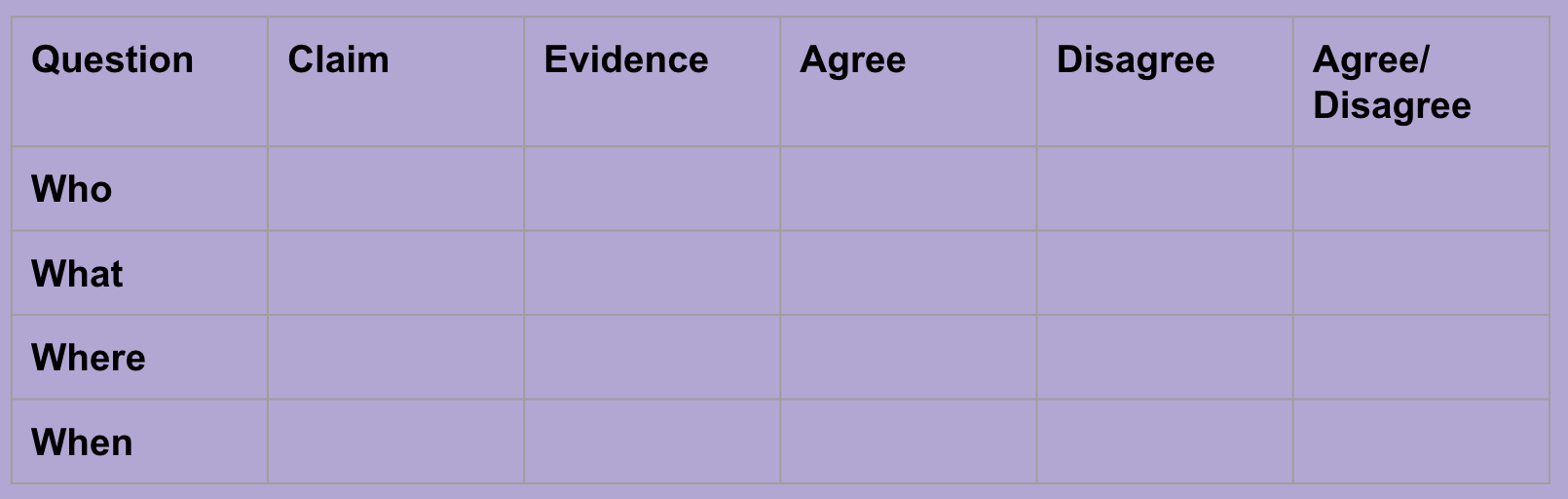
Disagreeing | Graff and Birkenstein. 2024. Chapter 4, “Yes/No/Ok, But” Three ways to Respond: Disagree — And Explain Why. 62-64.
- Social Media | Zhuravskaya, E., Petrova, M., & Enikolopov, R. (2020). Political effects of the internet and social media. Annual review of economics, 12(1), 415-438.
- Gambling | Wilber MK, Potenza MN. Adolescent gambling: research and clinical implications. Psychiatry (Edgmont). 2006 Oct;3(10):40-8.
- Investing |
Organizing your Argument | The 2,000-year-old, 4-part outline (arrangement) from Cicero:
- Four-part Ciceronian Arrangement for the second EN1250 writing assignment | (Consider reviewing section W5 in the Little Seagull, regarding parts of an essay including crafting your thesis statement. Also review notes on The Art of Summarizing).
- A few approaches from the Purdue Owl: Toulmins, Rogerian, Ciceronian
Week Seven | February 25 and 27
Tuesday |
Housekeeping and Noteworthy | Paper 2 What Do You Have to Say? Now due 11 March 2025
Reading For Tuesday 25 February | Warrington, K., Kovalyova, N and King. 2020. Assessing Source Credibility for Crafting A Well-Informed Argument. In: Writing Spaces: Readings on Writing. Volume 3. 189-201.
Reading For Thursday 27 February | Graff and Birkenstein. 2024. Chapter 5, “And Yet: Distinguishing What You Say from What They Say.” 74-83
Special Guest Lecture | Stephanie Diaz, MLIS (she/her). Librarian, Grasselli Library & Breen Learning Center. Topic | Slides from Stephanie’s talk => Finding and Evaluating Sources in a Research Library
Thursday |
Housekeeping and Noteworthy |
- Paper 2 What Do You Have to Say? Now due 11 March 2025
- Reading For Thursday 27 February | Graff and Birkenstein. 2024. Chapter 5, “And Yet: Distinguishing What You Say from What They Say.” 74-83
- Reading For Tuesday 11 March | Little Segal. 2024. Appendix: Writing With Generative AI.
- Journal Entry 3
Discussions |
Returning Essay 1 & important observations | Essay One Memorandum
Review of Guest Lecture | Stephanie Diaz, MLIS (she/her). Librarian, Grasselli Library & Breen Learning Center. Topic | Slides from Stephanie’s talk => Finding and Evaluating Sources in a Research Library
Essay 2 |
- Description and Goals
- Writer’s Memo
- Assessment Criteria
- Handing in Essay 2 with your Writer’s Memo
Topics and Articles Essay 2 | Use what you know from the workshop and more to evaluate your article(s) for Essay 2.
- Social Media | Zhuravskaya, E., Petrova, M., & Enikolopov, R. (2020). Political effects of the internet and social media. Annual review of economics, 12(1), 415-438.
- Gambling | Wilber MK, Potenza MN. Adolescent gambling: research and clinical implications. Psychiatry (Edgmont). 2006 Oct;3(10):40-8.
- Investing |
Getting into today’s Reading | Graff and Birkenstein. 2024. Chapter 5, “And Yet: Distinguishing What You Say from What They Say.” 74-83. Journal entry 3 involves address Exercise 1, pp. 81-82.
Week Eight | March 11 and 13
Tuesday |
Housekeeping and Noteworthy |
- Paper 2 What Do You Have to Say? Now due 11 March 2025
- Reading for 11 March | Little Segal. 2024. Appendix: Writing With Generative AI.
- Journal Entry 3
Discussions |
1. Returning Essay 1 & important observations | Essay One Memorandum
2. Essay 2
- Peer review | We will begin peer review on Thursday
- Feedback and The Writer’s Worksheet project
3. Using APA Style |
- Citation generator | Noodle Tools Citation Tool
- APA-style | In text documentation p. 214+
- Example text | Menary, R. (2007). Writing as Thinking. Language Sciences, 29(5), 621-632.
4. Thinking With Generative AI | Developing a dialogue with your AI Tutor
“Act as a writing tutor, an academic guide, a librarian…….” from the Little Seagull
- AI-2a | Craft Effective Prompts for Conversing with AI
- AI-2b | Craft Effective Prompts for Brainstorming with AI
- AI-2c | Craft Effective Prompts for Researching with AI
Thursday |
Housekeeping and Noteworthy |
- Assignment due Feedback The Writer’s Worksheet : Due Tuesday March 18
- Journal entry three | assessment forthcoming ASAP
Good peer reviews answer questions like “do readers understand the points I’m trying to get across, or are they reading me wrong?” and “am I using the right arguments and evidence for the audience I’m trying to reach?” (Purdue Owl)
Discussions |
Using APA Style | (Review)
- Citation generator | Noodle Tools Citation Tool
- APA-style | In text documentation p. 214+
Thinking With Generative AI | (Review) Developing a dialogue with your AI Tutor
Assignment Two | Essay 2 | What Do You Have to Say?
- Peer Feedback,
- Revisions
- Instructor Feedback
- Assessment Criteria
Essay 2
- Peer review | We will begin peer review today
- Feedback and The Writer’s Worksheet project
Week Nine | March 18 and 20
Tuesday |
Housekeeping and Noteworthy |
- Assignment due | Feedback The Writer’s Worksheet : Due today, Tuesday March 18
- Journal entry three | assessment completed
- Journal entry four | forthcoming, related to rhetorical analysis.
- Reading for Thursday 20 March | W-10b rhetorical analysis (from the Little Seagull)
- Reading for Tuesday 25 March | They Say / I Say. Chapter 8: So What? Who Cares? Saying why it Matters. pp. 112-122.
Discussions |
- Essay Three | Research Project with Annotated Bibliography and Proposal
- Essay Three Objectives (tentative)
- Analyze another’s argument concisely and appropriately.
- W-10b rhetorical analysis (from the Little Seagull)
- Selecting a text to start your research and analysis
- Specific Academic Contexts (They Say / I Say: Part four)
- Using academic databases (again)
Thursday |
Housekeeping and Noteworthy |
- Reading for Thursday 20 March | W-10b rhetorical analysis (from the Little Seagull)
- Journal entry four | forthcoming, related to rhetorical analysis.
- Reading for Tuesday 25 March | They Say / I Say. Chapter 8: So What? Who Cares? Saying why it Matters. pp. 112-122.
Discussions |
- Essay Three | Research Project with Annotated Bibliography and Proposal
- Rhetorical analysis
Week Ten | March 25 and 27
Tuesday |
Housekeeping and Noteworthy |
- Reading for Tuesday 25 March | They Say / I Say. Chapter 8: So What? Who Cares? Saying why it Matters. pp. 112-122.
- Reading for Thursday 27 March | They Say / I Say. Chapter 15: “But as several sources suggest.” pp. 205-233.
- Journal entry four | due Tuesday 25 March
- Let’s have a look at the grade book
Discussions |
- Essay Three | Research Project with Annotated Bibliography and Proposal
- Journal entry four target text | Barnes, E. 2024. The Fast and Fashionable: How your closet contributes to a global crisis. In: Graff, G., et. al. They Say/I Say with readings. New York: W.W. Norton & Company. 479-486.
- Rhetorical analysis (like a jigsaw puzzle) | Taking a Stance: from “data dumps to college level research”
- 1. Thesis and 2. Summary of the text
- 3. Who Cares: Chapter 8: So What? Who Cares? Saying why it Matters. pp. 112-122).
- 4. So What: Chapter 8: So What? Who Cares? Saying why it Matters. pp. 112-122).
- 5. Significance of context (or what conversation is Barnes’ essay a part of)?
- 6. Interpretation / reasoned judgement
- 7. Textual evidence to support your conclusions and 8. Conclusions
Thursday |
Housekeeping and Noteworthy |
- Reading for Thursday 27 March | They Say / I Say. Chapter 15: “But as several sources suggest.” pp. 205-233.
- Reading for Tuesday 1 April | W-17 Annotated Bibliographies (Little Seagull)
Discussions |
- Essay Three | Research Project with Annotated Bibliography and Proposal
- Searching for and identifying a topic and searching for sources
- Annotated Bibliographies W-17 Little Seagull. —
- “But as Several Sources Suggest: Research as Conversation” pp. 205-233.chapter 15 (Creating a scaffold to guide our research project). pp. 205-233.
- Develop a Good Research Question
- Let one good source lead to another
- Beware of Confirmation Bias
- Appreciate Scholarly Sources
- Evaluate your Sources
- Don’t let all those sources derail you
Week Eleven | April 1 and 3
Tuesday |
Housekeeping and Noteworthy |
- Reading for Tuesday 1 April | W-17 Annotated Bibliographies (Little Seagull)
- Reading for Thursay 3 April | W-15 Proposals (Little Seagull)
- Project Three | Annotated Bibliography and Proposal for Research Project. Due 11 April.
Discussions |
- Evidence supporting your assertions may take the form of facts, statistics, textual evidence, or personal experience.
- Beyond writing something like, I think it is bad, as Smith (2011) shares, “it is bad” (pp. 21-22).
- Please find a proper use of evidence in a written text to share.
- Annotated Bibliographies W-17 Little Seagull. —
- Project Three | Annotated Bibliography and Proposal for Research Project.
- “But as Several Sources Suggest: Research as Conversation” pp. 205-233.chapter 15 (Creating a scaffold to guide our research project). pp. 205-233.
Writing Workshop |
Thursday |
Housekeeping and Noteworthy |
- Reading for Thursay 3 April | W-15 Proposals (Little Seagull)
- Project Three | Annotated Bibliography and Proposal for Research Project. Due 11 April.
Discussions |
- Proposals W-15 Little Seagull.
- What is a problem? Can we broaden this?
- Help me solve this problem
- Have I got a fix for you
- Evidence: Data, Interpretation
- Project Three | Annotated Bibliography and Proposal for Research Project.
Writing Workshop |
Week Twelve | April 8 and 10
Tuesday |
Housekeeping and Noteworthy |
- Project Three | Annotated Bibliography and Proposal for Research Project. Due 11 April.
- First Year Writing Seminar Contest deadline for submissions 13 April
Writing Workshop |
- Library Research
- Topics
- Annotations ~7 and at least 3 academic sources.
- Proposal
- Writing contest
Thursday |
Housekeeping and Noteworthy |
- Project Three | Annotated Bibliography and Proposal for Research Project. Due 11 April.
- First Year Writing Seminar Contest deadline for submissions 13 April
Writing Workshop |
- Library Research
- Topics
- Annotations ~7 and at least 3 academic sources.
- Proposal
- Writing contest
Week Thirteen | April 15 and 24
Tuesday |
Housekeeping and Noteworthy |
- Revisions to either Essay 1 or Essay 2 Due 29 April
- Final Essay Due at time of the final exam, 8 May
- First Year Writing Seminar Contest deadline for submissions 17 April
- Reading for Thursay 24 April | Reading Chapter 12: “What I Really Want to Say Is” Revising Substantially. pp. 165-187
Writing Workshop | Towards Revisions.
- Feedback | The Writer’s Worksheet and Revision planning
- Reading Chapter 12: “What I Really Want to Say Is” Revising Substantially. pp. 165-187.
Thursday |
Housekeeping and Noteworthy |
- Revisions to either Essay 1 or Essay 2 Due 29 April – Today
- Final Essay Due at time of the final exam, 8 May
Writing Workshop | Towards Revisions.
- Feedback | The Writer’s Worksheet and Revision planning
- Reading Chapter 12: “What I Really Want to Say Is” Revising Substantially. pp. 165-187.
Week Fourteen | April 29 and May 1
Tuesday |
Housekeeping and Noteworthy |
- Revisions to either Essay 1 or Essay 2 Due 29 April – Today (Including updates to your writer’s memo).
- Final Essay Due at time of the final exam, 8 May
Thursday |
Housekeeping and Noteworthy | Final Essay Due at time of the final exam, 8 May
- Previously incomplete assignments are due on the last day of classes 2 May.
- Final Essay Due at time of the final exam, 8 May
Discussion | Write a paragraph about your final research essay:
- Characterize your thesis statement (in a sentence or two).
- On the one hand, what do they have to say? (Include in-line sources).
- On another hand, what more are they saying? (Include in-line sources).
- How are you responding? What is your argument in two to three sentences; what do you have to say? (Include in-line sources).
- Discuss some of your evidence in a sentence or two. (Include in-line sources).
- Discuss and learn about your paper from this conversation
Week Fifteen | Final Exam Thursday 8 May, 1:00pm-2:50pm
Final Essay Due at time of the final exam, 8 May
 Welcome to a Seminar on Academic Writing